Thursday, October 29, 2009

Oil Companies See Drops in Profits


Oil companies are reporting low earnings for the third quarter. The recession has left its mark on the demand for oil as people work to cut down on oil consumption. This lack of demand makes the price of energy such as oil lower and puts pressure on the oil companies. An article from the Washington Post reads:

The world's biggest oil companies are reporting sharp declines in quarterly profit as the recession continues to weigh on consumer demand, driving down energy prices.

Exxon Mobile, the world's largest oil company by market value, said Thursday that its third-quarter profit slumped 68 percent, to $4.73 billion (98 cents per share). That's down from $14.8 billion ($2.85), in the same July-September period a year ago, the most lucrative quarter ever for the oil industry, when crude oil prices neared $150 a barrel.

Royal Dutch Shell, meanwhile, said Thursday that its third-quarter profit fell 62 percent, to $3.25 billion, while sales tumbled 43 percent. Shell, Europe's biggest oil company, said it would cut 5,000 jobs and that 15,000 employees must reapply for employment.

The future of the oil companies is looking a little shaky and uncertain right now because of the lack of demand for oil right now as a result of the current economic conditions.

Economy Growth Causes Stocks to Rise


The U.S. economy grew 3.5% in the third quarter, which was much higher than predicted or expected. This was the first time that the economy has grown in a year. As soon as this news spread, the stock prices rose sharply. Javier C. Hernandez of The New York Times writes that,
By the time the markets closed, all the major averages had ridden the wave. The Dow Jones industrial average rose 199.89, or 2.05 percent, to end at 9,962.58. The Standard and Poor’s 500-stock index went up 23.48, or 2.25 percent, to 1,066.11. And the Nasdaq composite index, which is heavy with technology stocks, finished 37.94 higher, or 1.84 percent, closing at 2,097.55.
Hopefully this is a sign that the U.S. economy is recovering and his headed toward a future of further growth rather than contraction.

Wednesday, October 28, 2009

California Looking at Effects of Leagalizing Marijuana


Law makers for the state of California are reviewing the effects of the bill that would legalize marijuana and allow taxing of it in the U.S. It is estimated that the taxing of marijuana could bring the state around 1.4 billion per year. Jim Quinn, a production manager was quoted in a times article saying,
“Personally I don’t see a way of getting it under control other than legalizing it and taxing it...We’ve got to get it out of the hands of criminals both domestic and international.”
This presents an interesting aspect of the legalization of marijuana and how it will affect the international drug trafficking which cause been a major source of violence in the U.S. and neighboring countries, namely Mexico.

Tuesday, October 27, 2009

Bay Bridge Closed


The Bay Bridge, the busiest bridge in the bay area, has been closed due to pieces of a repair that was made earlier snapped off and hit the deck of the bridge. An article from the Chronicle says,


Caltrans officials ordered the closure of the bridge in both directions shortly after 7 p.m. and said they could not estimate when the bridge would reopen.


The pieces that snapped were two high-strength steel rods and a cross beam from a steel saddle, said Tony Anziano, Caltrans toll bridge program manager. Those parts were installed over Labor Day weekend during an repair job that delayed the reopening of the bridge following scheduled work.

This will be a major hassle for commuters, but very good for BART ridership. Bart is preparing for the increase in the numbers of riders by operating all of their trains.

Sunday, October 25, 2009

350 Global Warming Protests


Campaigners against global warming organized over 4,300 protests across the globe. The protests were synchronized to happen at the same time and were focused around the number 350.
For some prominent climate scientists, that is the upper limit for heat-trapping carbon dioxide in the atmosphere, measured in parts per million. If the gas concentration exceeds that for long, they warn, the world can expect decades of disrupted climate patterns, rising sea levels, drought and famine. The current concentration is 387 parts per million.
The organizers wanted to show that it was urgent that we need to do something about our emission since we passed the 350 parts per million mark long ago. It is amazing that they were able to organize something this big across the globe.

Piano Stairs

I want a set of these in my house if I become rich.

Monday, October 19, 2009

Biofuels Getting a Boost from Oil Companies


Many if the larger oil companies are now choosing to invest in biofuels. Low-carbon policies that are beginning to be adopted around the world are pushing the big oil companies to spend money on alternative fuels. Guy Chazan from The Wall Street Journal writes,
...The Renewable Fuels Standard mandates growth in annual sales of biofuels through 2022. The Department of Energy expects U.S. production of biofuels to increase from less than half a million barrels a day in 2007 to 2.3 million barrels a day in 2030. Inevitably, that will erode the oil majors' conventional business.
This is one of the main reasons that the big oil companies have started to gain interest in the biofuels section of the energy market because they know that they will have to start making progress with biofuels in order to survive later. These technologies will hopefully be used in the near future to power our cars and provide electricity for our homes, helping us reduce our thirst for oil.

White House Attacking Fox News


The White House is urging news networks to alienate Fox News, saying that Fox is "A Republican Party mouthpiece" and that they are "opinion journalism masquerading as news".

In a Fox news article Fox News senior vice president Michael Clemente responded, saying:
"Surprisingly, the White House continues to declare war on a news organization instead of focusing on the critical issues that Americans are concerned about like jobs, health care and two wars. The door remains open and we welcome a discussion about the facts behind the issues."

Micheal Clemente has a great point: Why would the Obama Administration concentrate on and concern themselves with something so petty and small when there are a mess of other, much more important, tissues that need to be delt with?

Rise In Medicare Premiums


The basic Medicare premium will increase by 15% next year. This would be the first time that monthly premiums would be over $100. Kathleen Sebelius, the secretary of health and human services, said in a Times Article:
“We are in tremendously difficult economic times, and seniors are being hit particularly hard...The last thing seniors need right now is a substantial increase in their Medicare premiums, and many seniors will see such an increase if no action is taken.”
However, only about 27% of those covered by medicare will have to pay this new higher premium because the remaining percent of people are legally protected from seeing their monthly premiums increase. These increasing costs of medical costs are just another indication that something has to done with our current healthcare system.

Declining Dollar Helps Exports

Does it seem possible that a falling dollar could actually help the economy? Well it helps exports at least. Nelson D. Schwartz from The New York Times writes in his article,
...A weak dollar could prove beneficial to the American economy by aiding long-suffering manufacturers, rebuilding a stronger industrial base and lifting exports even if it makes life harder for trading partners around the world, especially in Europe.
One point was that while it helps exports for the US, the decline in the value of the dollar hurts countries like Europe. Jens Nagel, head of the international department of the German Exporters Association in Berlin says that "The strength of the euro is coming at absolutely the wrong time".

This has had the opposite effect on imports however, because it drives up the prices of imported foreign goods. While the decline in the dollar has helped some aspects of the economy, it still has a large negative impact.

Wednesday, October 14, 2009

Hadron Collider Sabotaging Itself?


An essay written by Dennis Overbye explains that possibly
...The troubled collider is being sabotaged by its own future. A pair of otherwise distinguished physicists have suggested that the hypothesized Higgs boson, which physicists hope to produce with the collider, might be so abhorrent to nature that its creation would ripple backward through time and stop the collider before it could make one, like a time traveler who goes back in time to kill his grandfather.

It seems bizarre, but entertainingly makes sense in a way. Maybe this "doomsday device" is being sabotaged by the future...or we are just running into a bunch of bad luck.

Thursday, October 8, 2009

Alcoa Profits, Wall St. Gains


Stocks unexpectedly rose today with a surprise profit from Alcoa, gaining 1.1 percent. Jim Awad, managing director at Zephy Management in New York said, "You had more positive economic news, and Alcoa numbers were better than expected on both revenue and net income. So that lends credibility to the bulls' thesis that the economy is gaining momentum". This positive news is reinforced by stronger U.S. retail stores' sales and my be a sign that our economy may be on the beginning or just about to begin on the road to economic recovery.

Hate Crimes Redefined


The definition of a hate crime was expanded to include those committed because of a victim's sexual orientation, which would give gay, lesbian and transgender people protection under it.

Under current federal law, hate crimes that fall under federal jurisdiction are defined as those motivated by the victim’s race, color, religion or national origin.

The new measure would broaden the definition to include those committed because of gender, sexual orientation, gender identity or disability. It was approved by the House right before a weekend when gay rights will be a focus in Washington, with a march to the Capitol and a speech by President Obama to the Human Rights Campaign.
The altering of this definition was met by opposition from the republican side. John Boehner, the house republican leader said, "The idea that we’re going to pass a law that’s going to add further charges to someone based on what they may have been thinking, I think is wrong". Republicans are also unhappy that the measure included a $681 billion military policy bill. It is important that the definition of a hate crime is expanded to protect gays and lesbians, but is it fair to ensure that it passes by attaching a military policy bill to it.

Is Singapore Buying Babies?

$230 million was given out by the Singapore government as "Baby Bonuses" which were designed to provide incentives for Singaporean couples to have babies. Although the baby bonuses have undoubtedly resulted in more births of Singaporean babies, it has had a limited success overall.

Singapore is facing one of the worst baby droughts in the world. The total fertility rate (TFR) – or the number of children a woman is expected to have – fell a notch, from 1.29 to 1.28 last year. Only South Korea and Hong Kong have lower TFRs than Singapore. To replace itself, a population needs a TFR of 2.1 or higher.

While the TFR may have flagged a bit, take-up rates for the Baby Bonus Scheme have been increasing. About 19,000 new Child Development Accounts (CDAs) were opened last year, up from 14,000 in 2004.

Its interesting how a program offering such incentives hasn't really done more to help the situation. This Baby Bonus Scheme sounds very similar to the Cash for Clunkers Program in the U.S.


Mustache Growth and Economy Related?


The American Mustache Institute has released a new study that surveyed 2000 mustached men, 2000 clean shaven men,
The research found that Mustached Americans earned 8.2 percent more on average than those with beards and 4.3 percent more than the clean-shaven. People of Mustached American descent, however, also tended to spend 11 percent more and save 3 percent less than their collective counterparts.
The spending portion seems to make little sense until the survey states its findings that
...The majority of Mustached Americans' disposable income was spent on toiletries such as cologne, and teeth whitening solutions (10 percent); alcoholic beverages such as beer and Rich & Rare Canadian Whisky (11 percent); 1970s and ‘80s-era music memorabilia, most commonly by Hall & Oates (1 percent)
Maybe if more people were to grow mustaches and develop new spending habits, we would see the economy pick up again...


Gains in Retail Sales from a Year Ago

Retail sales are the best that they have been all year, but are only at levels seen back in 2005. Stephanie Rosenbloom from the New York Times says in an article that she wrote,
Over all, for September, the retailing industry posted a 0.6 percent sales increase for stores open at least a year, according to Thomson Reuters. That figure is higher than analysts expected, and underscores that the rate of economic deceleration has stabilized. Several chains on Thursday also increased their earnings guidance.

Hopefully this is a sign that our economy is beginning to stabilize and slowly start picking up again, although it seems that it will be awhile before the economy fully recovers.

Our Plan in Afganistan


President Obama and his advisers are deciding whether the United States need to boost the number of troops in Afganistan. The war in Afganistan is in its eighth year and is one of the major problems that President Barack Obama has to deal with.
Obama is considering whether to continue with a war strategy he approved in March that emphasizes protecting and supporting Afghan civilians and training local army and police. That approach would require a change in tactics and more troops than the 68,000 the U.S. is scheduled to have in the theater by the end of this year, McChrystal said in an Aug. 3 assessment of the security situation in Afghanistan.
It is generally agreed upon that there needs to be an increase in the number of forces in Afganistan. The U.S. may be looking to add as many as 40,000 more forces into Afganistan.

Whitehouse spokesman Robert Gibbs says that "Pulling all U.S. troops from Afghanistan isn’t under consideration".

Thursday, October 1, 2009

Swine Flu Vaccine in Time for Flu Season

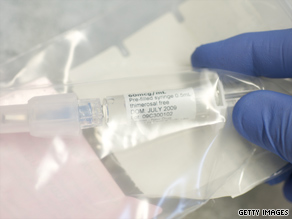
The vaccine for H1N1 influenza began being shipped at the beginning of this week. The first round of vaccine being shipped are in the form of nasal sprays and are being sent to locations through out the country. Even something such as a flu pandemic can have a great effect on our economy. This is why it is important that we try to minimize the effects of it and push for people getting the vaccinations.

Autosales Drop Without Clunkers Program

With the end of the government's Cash-For-Clunkers program, the number of cars being sold has dropped back to levels that were seen before the clunkers program was launched. The head of Chrysler's sales organization, Peter Fong, said, "We believe the remainder of 2009 will continue to be a challenge for the U.S. automotive market". The article states,
The good news for automakers is that the market is no longer deteriorating, though it is not improving very quickly. Also, the clunkers program cleared out inventories at many dealerships, leading G.M., Ford and other manufacturers to increase production at some plants and call back thousands of laid-off workers to their assembly lines. The depleted stocks hindered sales at many dealers in September but left the automakers in a better position to compete and make profitable sales in the months ahead.
Although that it may seem that the cash for clunkers was only a temporary program that did little to help the auto industry, the reasons stated above support the fact that it did more than just give a little boost on sales of cars. It could not be expected that the number of car sales would remain as high as they were when the program was still in operation.

Iran Sending it's Uranium to Russia


Iran has agreed to transfer a large amount of their supply of nuclear fuel to other countries to have it enriched, possibly reducing Iran's ability to produce bombs temporarily. Western officials said that "Iranian negotiators agreed in principle to ship part of their stockpile of enriched uranium to be reprocessed in Russia and France to create new fuel rods for an aging medical-research reactor in Tehran". This decision may be a sign that we are moving in the right direction with negotiations with Iran regarding their nuclear program, although it is obvious that this issue will not be resolved for quite awhile.

America's Unemployment Problem


Andrea Orr from the Economic Policy Institute says,
The official unemployment rate hovers near 10%, suggesting that one in 10 American workers is out of work. But that figure masks the extent to which unemployment has devastated American families. Almost one in four families say they have been hit by a job loss over the past year, a new survey finds, and 44% have suffered either the loss of a job or a reduction in wages or hours worked.
This chart and survey help show how widespread unemployment is right now and how it has affected individuals in America. This high unemployment rate is just one of the many indications and contributing factors of our poor economy at the moment.

Dealing With Iran's Nuclear Program

The U.S. says that it will not push for sanctions to be put on Iran in negotiations with the aspiring nuclear power of a country. Officials said that "Iran faces a 'very, very stark choice' to either abandon its pursuit of weapons-grade nuclear material or face 'isolation, pressure, sanctions and other steps.'" The U.S. is requiring that Iran allows inspections of their nuclear facilities or sanctions will be put on the country hopefully in addition to sanctions placed on Iran by other countries. It is important that the U.S. and the rest of the world finally confront Iran about their nuclear facilities because much hasn't been done in the past to handle this escalating situation.

Massive Earthquake Devastates Indonesia

An earthquake with a magnitude of 7.6 has resulted in the death of 464 people with that number expected to rise in the next few days. The next morning the are was shaken with a quake of a 6.6 magnitude. Another separate earthquake with a magnitude of 8.0 in the middle of the Pacific Ocean triggered a tsunami that hit the islands of Samoa, American Samoa, and Tonga. The photos of the aftermath of these disaster struck areas brings back memories of the tsunami that hit India in December 2004 that killed many and caused immense amounts of damage.